20 Interesting Facts About Food In Italy You Should Know
This food facts about Italy post was first published on the 20th March 2024.
Italy is well known worldwide for its beautiful landscapes and culture, and most of all for food. Italian cuisine and food are some of the reasons why you should visit the Bel Paese. And what better way to visit or read about Italy than with some curious facts about food in Italy?
In Italian culture, food takes an important role when meeting with friends and family, which people take very seriously in the peninsula. You will surely be offered food left and right if invited into an Italian home. Think about the grandmother figure, a lot of ‘nonnas’ are like that for real! So I hope you are ready to find out some curious and interesting facts about food in Italy and share any traditional Italian food recipes you might need!

Italian cuisine is very regional – facts about food in Italy
Italian food is very regional, depending on the historical, cultural, climate and landscape differences. This means that every region has their own specialities and sometimes the same dish can take different names or use different ingredients in the same region for example pane cunzato, this dish is made with different ingredients depending on the Sicilian village you are in. Some of the most popular Italian foods are:
- Liguria: Located in northwestern Italy, Ligurian cuisine is known for its focus on fresh seafood, olive oil, herbs, and vegetables. Farinata di ceci is a popular street food that is made with chickpea flour and take different names depending on the locality. Pesto Genovese, made with basil, pine nuts, garlic, Parmesan cheese, and olive oil, is a famous Ligurian sauce often served with pasta like trenette or trofie.
- Piedmont: In the Piedmont region, truffles, mushrooms, and rich meats like beef and veal feature prominently in the cuisine. Risotto al Barolo, made with the famous Nebbiolo wine, and bagna cauda, a warm garlic and anchovy dip served with vegetables, are popular dishes.
- Tuscany: Tuscan cuisine is characterized by its simplicity and use of high-quality ingredients. Ribollita, a hearty bean and vegetable soup, and bistecca alla Fiorentina, a thick-cut T-bone steak seasoned with salt and olive oil, pesce finto and more are iconic Tuscan dishes.
- Emilia-Romagna: Often referred to as the “food valley” of Italy, Emilia-Romagna is famous for its rich and indulgent dishes. Parmigiano-Reggiano cheese, friggione, prosciutto di Parma, torta tenerina, panpepato, balsamic vinegar from Modena, cannelloni bolognese, white ragù, torta tenerina, gnocco fritto and fresh pasta like tortellini and tagliatelle are staples of the region.
- Campania: Campanian cuisine, centered around Naples, is known for its pizza, pasta, casatiello, roccocò cookies and seafood dishes. Neapolitan pizza, made with San Marzano tomatoes, buffalo mozzarella, and fresh basil, is a UNESCO-recognized cultural heritage. Spaghetti alle vongole (spaghetti with clams) and mozzarella di bufala are other specialties.
- Sicily: Sicilian cuisine is influenced by its rich history of Greek, Arab, and Spanish rule. Arancini, deep-fried rice balls stuffed with ragù, peas, and cheese, caponata, a sweet and sour eggplant dish, impanata, pane cunzato, pesto alla siciliana are popular Sicilian antipasti. Anything made with Pistachio, known as the green gold like pistachio cream, pistachio granita and pistachio liqueur or with almond like almond milk, almond cream, almond liqueuer and almond granita. Busiate, pasta alla Norma, made with eggplant, tomatoes, and ricotta salata cheese, is a classic Sicilian pasta dish.
- Veneto: Venetian cuisine highlights the bounty of the sea and the northern italy fertile plains. Risotto al nero di seppia, a creamy risotto made with cuttlefish ink, and sarde in saor, marinated sardines with onions, pine nuts, and raisins, are traditional Venetian dishes. Another typical dessert is surely frittelle di carnevale and a typical drink like spritz.
- Sardinia: Sardinian cuisine is rustic and hearty, reflecting the island’s rugged terrain and pastoral traditions. Culurgiones, handmade pasta stuffed with potatoes, cheese, and mint, and porceddu, suckling pig roasted over a wood fire, malloreddus, another type of pasta are iconic Sardinian dishes.

Italian bread is very regional and has over 250 types of it – facts about food in Italy
Another intangible cultural heritage of Italian cusine must be bread! It’s one of those food that can’t miss in an Italian house and as much as with the rest of the cusine, it’s very regional! The love for bread in the Bel Paes is probably only second to pasta and pizza!
With over 250 types of bread in the peninsula, as with the rest of the popular Italian foods, even bread is very regional. Among the many:
- Piemonte – is well known for grissini (crunchy, thin breadsticks, often flavored with herbs or seeds), pane di Chianale ( Rustic rye bread from the Alpine valleys, often paired with cheese) and Focaccia Novese ( A soft, olive-oil-rich bread from the Novi Ligure area).
- Lombardia – well known for Michetta (a hollow, airy bread roll with a light crust, perfect for sandwiches), Pan Tramvai (sweet bread with raisins, traditionally eaten as a snack) and Pane di segale (Dense rye bread, common in mountainous areas).
- Veneto – is well known for ciabatta (rustic loaf with a chewy crust and airy interior), Pinza Veneta (sweet bread made with polenta, dried fruits and anise) and Fugassa (version of sweet focaccia enjoyed during Easter).
- Liguaria – well known for focaccia Genovese (olive oil rich with a golden crust), farinata (chickpea flatbread, savoury) and pandolce (sweet dense bread with dried fruits, pine nuts popular at Christmas).
- Trentino Alto Adige – well known for vinschger paarl (rye rolls spice with coriander and cumin), zelten (festive sweet bread with dried fruits and nuts) and pan de moolche (mixed with molche, the solid residue of the processing of olives).
- Friuli Venezia Giulia – well known for gubana (spiral shaped sweet bread), pan di sor (sweet cornmeal loaf) and brovada bread (rye and wheat bread traditionally paired with pork and fermented turnips).
- Emilia-Romagna – Famous for coppia ferrarese (twisted bread with a crunchy crust), piadina romagnola (a flatbread often stuffed with cheese and ham), and torta degli addobbi (a sweet bread made with rice and raisins for celebrations).
- Tuscany – Known for pane toscano (saltless bread ideal for soups and cured meats), schiacciata (flatbread similar to focaccia, often with grapes or rosemary), and buccellato di Lucca (a sweet bread with raisins and anise).
- Umbria – Famous for pane umbro (rustic, crusty bread with a dense crumb), torta al testo (griddle-cooked flatbread served with cured meats), and panpepato (spiced bread with honey, nuts, and chocolate).
- Lazio – Renowned for pizza bianca (thin bread similar to focaccia, often served plain or stuffed), pane casareccio di Genzano (fragrant, crusty bread made with natural yeast)..
- Marche – Well known for crescia (flatbread made with lard and olive oil), pane di Chiaserna (soft wheat-based bread with a thin crust), and pane con le noci (walnut bread popular during harvest season).
- Puglia – Celebrated for pane di Altamura (DOP-protected durum wheat bread), friselle (twice-baked bread rings soaked and topped with tomatoes and olive oil), and puccia (small round bread stuffed with olives or other fillings).
- Campania – Famous for pane cafone (rustic bread with a thick crust), taralli (savory or sweet crunchy bread rings), and casatiello (savory Easter bread filled with cheese, salami, and eggs).
- Calabria – Known for cucciddatu (ring-shaped bread with fennel or anise), pane di Cerchiara (large, rustic bread baked in wood-fired ovens), and pitta (round flatbread often filled with savory ingredients).
- Basilicata – Renowned for pane di Matera (durum wheat bread with a thick crust), strazzata (circular bread flavored with black pepper), and focaccia ripiena (stuffed focaccia with seasonal fillings).
- Sicily – Well known for pane nero di Castelvetrano (dark, nutty bread made with toasted wheat flour), mafalde (sesame-coated spiral or braided bread), and cudduruni (stuffed flatbread with vegetables or anchovies).
- Sardinia – Famous for pane carasau (thin, crisp flatbread known as “music paper bread”), pane coccoi (beautifully shaped celebratory bread), and moddizzosu (soft, round bread made with semolina flour).
Italy is the 2nd largest producer of olive oil in the world – facts about food in Italy
Italy is only second to Spain in the world production of olive oil. Also, Italy is the world’s third largest consumer of olive oil, right behind Greece and Spain. (Olive oil)
Italy boasts a diverse range of olive-growing regions, each with its own unique terroir and olive varieties. Major olive oil-producing regions include Tuscany, Umbria, Liguria, Puglia, Sicilia, Sardinia and Calabria, among others. Each region’s climate, soil, and elevation contribute to the flavor profile and characteristics of its olive oils.
Italy is home to plenty of indigenous olive varieties, each with its own distinct flavor, aroma, and oil characteristics. Some of the most famous Italian olive varieties include Frantoio, Leccino, Moraiolo, Coratina, and Taggiasca. Different olive varieties are often blended to create balanced and complex olive oils. Italians eat extra virgin olive oil regularly, whether as a base for cooking or as a condiment.
Italy is the biggest producer of wine in the world – facts about food in Italy
When talking about facts about food in Italy we can’t forget about wine! Italy and France have been the major wine producers in Europe and the world for years. Italy alone produces every year five billion litres of wine. (Statista)
This tradition of winemaking dates back to ancient times. The Greeks, Etruscans, and Romans all contributed to the development of Italy’s wine culture, introducing new grape varieties, winemaking techniques, and cultivation practices. This has brought the count of grape varieties in the peninsula today to more than 350.
You can find wineries in almost every region, although the biggest production is in Veneto (where 1/4 of the whole country’s production is made, closely followed by Puglia and Emilia Romagna. Also, each region produces its unique varieties, such as Chianti and Brunello di Montalcino from Tuscany, Barolo and Barbaresco from Piedmont, Prosecco and Amarone from the Veneto region and Nero D’Avola and Etna wines from Sicily, just to mention some Italian wines.
Italy has so many snacks to offer – facts about food in Italy
When you think about snacking, you will hear a lot of people saying that you don’t snack as much in Italy. But it’s one of the facts about food in Italy that I have to deny. From mid-morning snack to the afternoon merenda or quick aperitivo before dinner, the chances to snack from kids to adults are endless! And what better way to bring back a piece of the Bel Paese back home or to your friends as a gift after travelling in a snack form?
When I used to travel back to London after a visit to our parents, snacks were the first thing to get in the bag. Call it how you like, food comes first!

Italy has a long history with cheese production – facts about food in Italy
Cheese production in Italy dates back to Roman empire and Etruscan times! As early as the 1st century A.D., Romans invented cheese presses to press cheese curds and they were also the first ones to start aging them. (iGourmet)
During the Middle Ages, cheese production in Italy flourished as monasteries and local communities developed specialized techniques for making cheese. Many of today’s cheese-making traditions originated during this period, with different regions developing their own unique styles and varieties. Cheese is one of the most popular ingredient in a lot of italian dishes and used a lot in Italian cooking, from filled ravioli to starring on burrata panzanella or filling eggplant rolls.
Italy has the highest number of cheese varieties in the world – facts about food in Italy
While Italy is not the biggest cheese producer in the world, it boasts 2500 different types of cheese. Yes, that’s not a typo at all! And most region has local cheeses too! The most famous Italian cheeses can be divided into:
- Hard Cheeses: like Parmigiano Reggiano, Grana Padano, Pecorino Romano, and Asiago. These cheeses are typically aged for an extended period, resulting in a firm texture and complex flavor.
- Soft Cheeses: like Mozzarella, Burrata, and Ricotta are examples of soft cheeses that are made from cow’s, buffalo’s, or sheep’s milk. These cheeses have a creamy texture and mild flavor.
- Blue Cheeses: like Gorgonzola and Taleggio are famous examples of Italian blue cheeses. These cheeses are characterized by their distinctive blue-green veins and bold, tangy flavor.
- Semi-Soft Cheeses: like Fontina and Provolone are semi-soft cheeses with a smooth, creamy texture. They are often used in melting or as filling, such as in sandwiches, pasta dishes, or cheese sauces.
Parmesan Cheese is Protected by Law – facts about food in italy
Parmigiano Reggiano is produced in strictly defined areas. All of the cheese wheels with a DOP status are produced in the provinces of Parma, Reggio Emilia, Bologna (west of the Reno river), Modena and Mantova (on the right bank of the Po river). Wheels are aged from 12 months (at least) up to 40 months, developing a complex, nutty flavor that pairs well with pastas, soups, or even enjoyed on its own.
When the first aging time of 12 months is past, the Consorzio (group of experts) gets to analyze every wheel and decide whether or not to apply to the Parmigiano Reggiano DOP sign. What doesn’t pass the test, is not sold as a true dop product.
Italy has more than 350+ types of pasta – facts about food in Italy
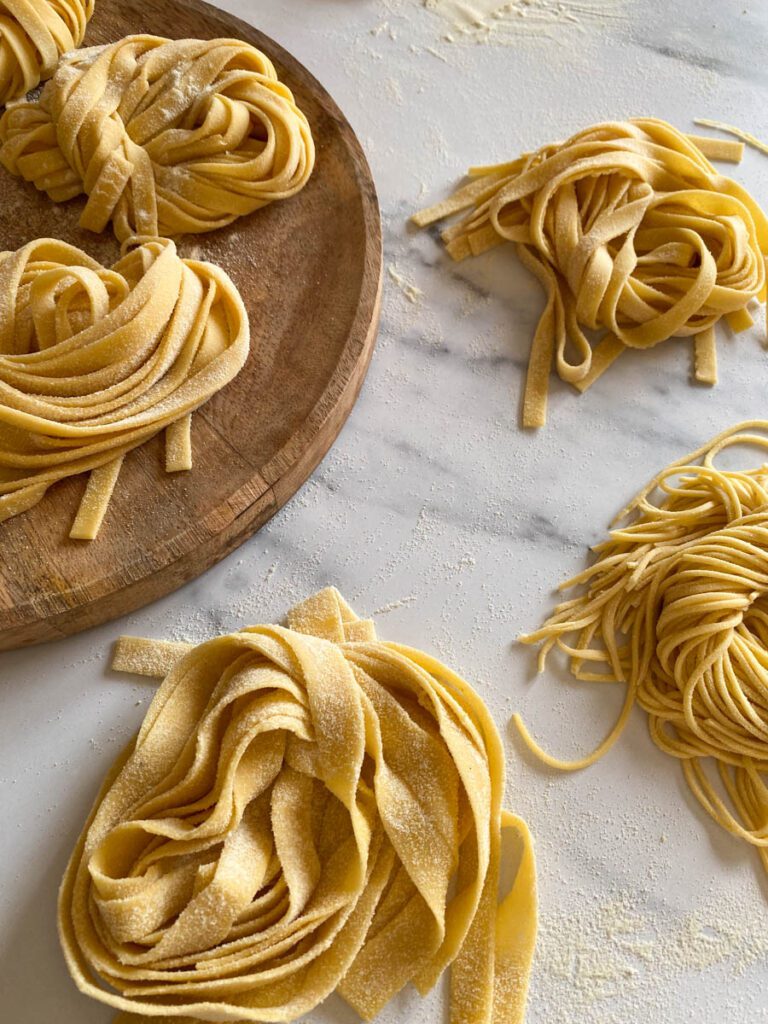
Facts about food in Italy couldn’t forget about pasta! Italy has 350+ different pasta shapes (some claim even 600). From the most famous spaghetti, pennette, rigatoni, farfalle, lasagna, gnocchetti, trofie, tagliatelle to the lesser known like ciriole, busiate, agnolotti, mafalde, festoni and maltagliati.
If you translate, most pasta shapes have funny names like ‘orecchiette‘ translates to ‘small ears’, ‘farfalle’ translates as ‘butterflies’, ‘rotelle’ translates as ‘little wheels’, ‘strozzapreti’ translates as ‘priest stranglers’ and ‘vermicelli’ translates as ‘little worms’ to mention a few.
Every region then might call the same pasta shape in different ways and pair it with different sauces, hence the difference in numbers. Italian pasta culture is so important and decided to take you on a journey to homemade pasta making. We have created a free pasta guide for all of you! You can learn how to make pasta without a machine or easy vegan pasta in no time!
Italians are the biggest pasta consumers and producers in the world – facts about food in Italy
It might not exactly come as a surprise that we have quite a few facts about Italian pasta! Italy alone boasts a whopping 1.3 million tons of pasta consumed, averaging a 23 kg of pasta per capita in a year (EFA). Must admit I think I am well over the 23 kg a year of pasta!
Italy food culture might not only be pasta based, but even the numbers for world pasta production place Italy at first place. With an amazing 3.6 millions tons of pasta produced in 2023.
Cook pasta ‘al dente’ – facts about food in Italy
This might be one of the facts about food in Italy I totally stand behind this! If there’s something that living in an English country taught me, most people don’t follow instructions on the pasta packet and butcher pasta, as well as putting pasta in a can (it’s a NO!). You don’t want an overcooked shapeless thing to eat, no matter how good your sauce can be.
Cooking pasta ‘al dente’ will make a whole lot of difference and I can assure you it will be a game changer too! Don’t break long pasta to fit it in a pot, it will go down after a couple of minutes when you stir. And for the love of things, don’t put pasta in a food processor (I have seen this on Instagram and asked myself why).
Tomatoes are very popular in Italy -facts about food in Italy
Think of sauces, fillings, salads and more. ‘Pomodori’ are one of the easiest ingredients to find in any Italian meal and home. First introduced in 1548 by the Spanish conquistadores, they didn’t have a warm reception in Europe but grew in popularity later on.
Now tomatoes are one of the most popular ingredients for salads like this delicious burrata panzanella, the main character for ragu like in this nduja ragu and one the most popular tomato sauces for pasta like this baked mostaccioli or used sundried like in this pasta alla crudaiola from Puglia.
Some so-called ‘Italian dishes’ are not really Italian – facts about food in Italy
We have written a full post about dishes that are not really Italian like chicken on pasta or pizza. It’s not really a thing, no matter how much people love to say chicken alfredo is an Italian dish. On that note, Alfredo sauce is not a thing in the Bel Paese, the Alfredo pasta was born in Italy though, but it was only made of parmesan and butter, nothing fancy.
Pepperoni pizza is not the same as what you get anywhere else, ‘Peperoni’ here are peppers, so make sure to order pizza with salami if you want pepperoni pizza. And last but honestly not least, if not the most important, cream and carbonara don’t fit on the same plate! Creaminess is achieved with pasta water and egg, and please no ham or in it bacon, it’s guanciale! And yes, you can warm up your pizza – follow these instructions on how to do so using an air fryer.
Italy hosts a lot of food festivals – facts about food in Italy
Italy food culture doesn’t stop at home, but also everywhere you go. There are plenty of food festivals and slow food coventions during the year that showcase the specialities that the Bel Paese has to offer. From the truffle festival in Alba to the chocolate festival in Perugia. Food festivals not only showcase food but also drinks, like the famous wine festival in Tuscany and the Limoncello festival in the Costiera Amalfitana.
There are also more local and regional food festivals held during the year called ‘sagre’. These are a chance for people to meet, listen to live music, find entertainment, participate in cooking demonstrations and enjoy local specialities.
Coffee culture is very important in Italy – facts about food in Italy
Coffee is a serious affair in Italy and one you have to try when travelling here. Italians usually drink an espresso while standing at a bar, having a quick break from work or a chat with a friend. But you will also find a lot of people having coffee at home with the classic Moka or enjoying coffee with milk for a quick breakfast.
Coffee was first introduced in the 16th century in the Venetian ports and then all over Europe. Coffeehouses, known as “caffè,” quickly became popular gathering places for intellectuals, artists, and politicians to socialize, discuss ideas, and exchange news.
Italian coffee per excellence is the Espresso – a rich, aromatic shot of coffee with a layer of crema on top. Espresso is typically served in small ceramic cups and enjoyed throughout the day, either standing at a bar counter or seated at a cafe table.
italian coffee culture is not just about the beverage itself but also about the social rituals, traditions, and sense of community that accompany the coffee-drinking experience. An integral and important part of the daily life in Italy.
Make sure to know the difference when ordering coffee – facts about italian foods
Between the many facts about food in Italy, one you should be very careful about is when ordering coffee in Italy. Espresso might be the standard for a quick drink, but when at the bar you can order an array of drinks.
When ordering a latte, unless they are used to having tourists around, you will likely get a glass of milk. Order a ‘caffé latte’ which equals to a usual milky coffee in other countries. Last but not least, as much as people rant about this, order your cappuccino at whatever time it suits you, they might think it’s weird, but you do you!
Gelato is Different From Ice Cream – facts about food in Italy
Gelato has a lower fat content (4-9% compared to ice cream’s 14-25%) and is churned more slowly, incorporating less air. This results in a creamier texture and more intense flavors. Florence is credited as the birthplace of gelato, with the first modern gelato maker (as we know it), Bernardo Buontalenti, presenting it in the 16th century at Caterina De Medici’s court.
History calls for plenty of similar dessert or tecniques to make gelato to be already popular in different cultures to keep food for longer and make different desserts to savour during the warmer months.
Venice has one of the oldest coffee houses in the world – facts about food in Italy
Caffé Florian in Venice opened its doors in 1720, making it the second oldest coffee house in the world, the first being Café Procope in Paris. Moreover, it was the first one to open its doors not only to men, but to women too.
A lot of famous writers and patrons visited the coffee house often, like Dickens, Byron, Goethe, Casanova and Goldoni. The outside and inside alike are filled with art and paintings and let you take a step back in time.
Pizza as we know it was invented in Naples -facts about food in Italy
Pizza’s origin is still very murky, but you can be assured that some sort of precursor already existed during Roman times with a sort of focaccia and in other countries with flatbreads. The word pizza was first used in Gaeta in 997 AD. Pizza as we know it evolved from a flatbread dish typical of Naples.
There’s a popular story as to how ‘Pizza Margherita’ was born and named after the queen consort Margherita of Italy during a visit in 1889. But in reality, pizza margherita with mozzarella, basil and tomato sauce, was invented at the beginning of the 1800s. As well as pizza marinara, typical of Naples since 1734. (Wikipedia)
Italy has a lot of Christmas markets – fun italian food facts
What screams food better than Christmas festivities? Italy has so many Christmas festivals & markets that are filled with love delicacies from savoury to sweet, drinks and more, so that everyone can enjoy! And on top of the amazing food, these markets are filled with gift ideas, artisan presents you can’t find anywhere and plenty of lights and attractions!
We are at the end of these interesting facts about italian food list!
I love how researching for these more niche pieces always gives me a chance to learn something new about the country I was born into! I hope you enjoyed reading and found something new to tell your friends randomly during a chat about the Bel Paese!
Would you add any more traditional Italian food culture facts? Did you know any of these Italian foods fact before? Let us know in the comments!
Pin these facts about food in Italy for later!