

Scrippelle: A Wonderful Culinary Journey Through Abruzzo’s Time-Honored Crepes
This scrippelle soup recipe was first published on November 29, 2023.
We are preparing for our second Christmas in Italy, and these Scrippelle have to have centre stage in our house. It happens to be yet another Christmas we won’t be spending in Rome with part of our family, where our grandad lived until he passed away a couple of years ago. And this dish is one his mum used to make, and his wife made for him every year for Christmas since they got married.
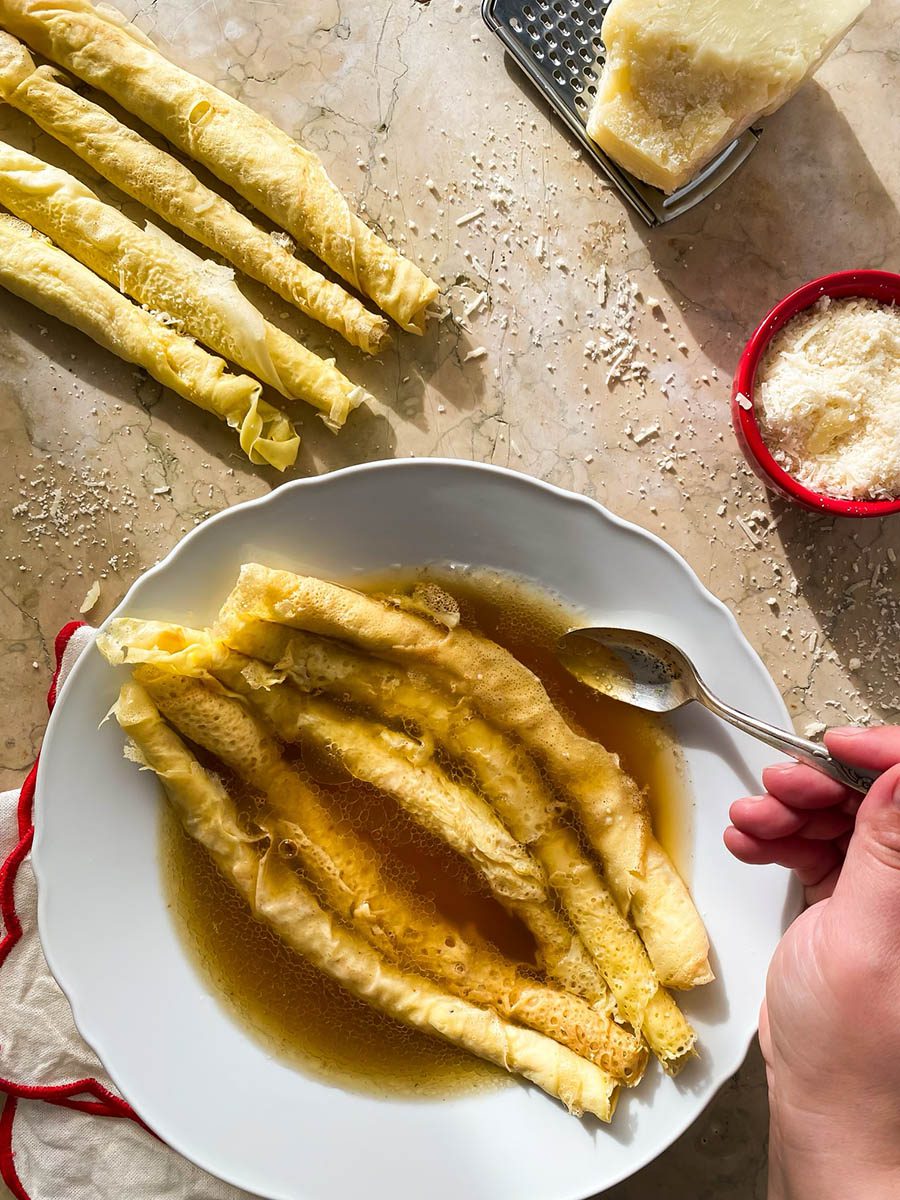
While we always called it differently, we called it scorpelle, somehow down to a dialect version based on the origins of our great grandparents, the actual scrippelle dish it’s just what we have seen as we researched the ins and outs of this dish. Extremely thin crepes, filled with a mix of grated cheese, rolled and served over hot chicken broth. While they don’t seem like much on paper, trust me when I say these Scrippelle are one of the most delicious dishes you’ll ever try.
But let’s focus on the actual Scrippelle recipe now. Let’s get to chat about their origins and all the details on how to make this perfect dish, one ingredient at a time.

Scrippelle, a tradition as old as time of poor origins and rich flavours
Scrippelle, derived from the Italian word scripp, meaning small pieces of paper, is a dish deeply rooted in Abruzzo’s culinary history. Its origins can be traced back to the rustic kitchens of Abruzzo’s households, where resourcefulness and a deep connection to the land shaped the way families prepared and enjoyed their meals.
Nestled in the heart of Italy, the region of Abruzzo boasts a rich culinary heritage that has given birth to some of the most exquisite and comforting dishes in Italian cuisine. Among these treasures is the beloved Scrippelle, a dish that transcends generations, weaving a tapestry of flavour, tradition and love. In this exploration, we will delve into the origins, history, and preparation of Scrippelle, uncovering the secrets that make it a timeless favourite among those who appreciate the artistry of Italian cooking.
The dish itself is a type of thin crepe, delicate and versatile, making it a canvas for various fillings and accompaniments. Its simplicity belies the complexity of flavours that emerge when each layer is carefully crafted, embodying the essence of Italian home cooking.
The History of Scrippelle: A Culinary Tale Passed Through Generations
The history of Scrippelle is a tapestry woven with threads of tradition, handed down through generations with love and care. The dish has been a staple in Abruzzo’s households for centuries, adapting and evolving as each family adds its unique touch to the recipe.
In the cold winter months, Scrippelle often takes centre stage in comforting soups, providing warmth and sustenance to families gathered around the table. The versatility of Scrippelle extends beyond soups, as these delicate crepes find their way into a variety of dishes, from savoury to sweet, showcasing the adaptability that characterizes Abruzzo’s cuisine.
Ingredients that Define Scrippelle
To embark on the journey of making Scrippelle is to embrace a harmony of flavours that define this quintessentially Abruzzo dish. The key ingredients, carefully chosen and thoughtfully combined, contribute to the dish’s unique taste and texture.
- Crepe Batter: Creating the perfect Scrippelle starts with a simple yet crucial crepe batter. Made with basic ingredients such as flour, eggs, and water, the batter is a testament to the beauty of uncomplicated recipes that yield extraordinary results;
- Chicken Broth: The soul-warming element of Scrippelle often lies in the rich, homemade chicken broth (similar to what you would use for chicken soup). Simmered with herbs and vegetables, the broth imparts a depth of flavour that elevates the entire dish;
- Pecorino Romano and Parmesan Cheese: A combination of these two cheeses adds a layer of complexity to Scrippelle. The sharpness of Pecorino Romano and the nuttiness of Parmesan create a balanced flavour profile that enhances the overall dining experience.
The Art of Making Scrippelle: A Labor of Love in Every Fold
Creating Scrippelle is not just a culinary task; it’s an art form passed down from one generation to the next. A bit like we did with our great-grandmother to our grandmother, and then this same grandmother to our mother – even though she has kept the right amounts a secret. But never mind, this is such a recipe where the perfect amounts do not matter.
The process involves a series of steps, each requiring precision and patience to achieve the desired result. A couple of burnt fingers later, though, and no more fingerprints for a few weeks, we got to enjoy that flavour of family gatherings, old happy memories and collect a family recipe we will be sharing with the next generation.
Let’s check out those steps before we get into it in detail:
- Making the Crepes: In a small nonstick skillet over medium heat, the crepe batter is skillfully poured and spread super thinly to create the delicate crepes that are the foundation of Scrippelle. The crepes are cooked to perfection, achieving a golden hue that hints at the delights within;
- Preparing the Chicken Broth: Simultaneously, a homemade broth is crafted, infusing the kitchen with the comforting aroma of simmering herbs and spices. This broth becomes the nurturing base for the Scrippelle, transforming a simple crepe into a culinary masterpiece;
- Filling and Folding: Once the crepes and broth are ready, the real magic happens. Each crepe is filled with a small handful of grated Pecorino Romano, and Parmesan cheese, then served over a ladleful of homemade broth. The crepe is then expertly folded into a compact parcel, ensuring that every bite is a symphony of flavours.
Scrippelle Beyond the Bowl: A Culinary Versatility
I have to admit, I fell down a rabbit hole when researching about italian scrippelle, especially because of the number of dishes you can make using these extremely thin crepes. I only knew of scrippelle with boiling broth (which I then discovered are typical of Teramo and known as scrippelle mbusse), so you can imagine my surprise. I am already planning to recreate some of these dishes, and I think you should too!
While Scrippelle shines as the star of many heartwarming soups in boiling borth, its culinary versatility extends far beyond the broth recipe. The crepes can be used in various dishes, each highlighting the adaptability of this beloved Abruzzo creation.
- Scrippelle Lasagna: Layering Scrippelle with rich Bolognese sauce and béchamel, akin to a more traditional lasagna, creates a unique twist that showcases the crepes’ ability to absorb and complement bold flavours;
- Scrippelle Cannelloni: Rolled and filled with a savoury ricotta and spinach mixture, Scrippelle can be transformed into elegant cannelloni, offering a lighter alternative to the classic pasta dish. Already drooling at the thought of it;
- Scrippelle Dolci: Embracing the sweet side of Scrippelle, the crepes can be filled with sweetened ricotta, drizzled with honey, and dusted with powdered sugar, creating a delightful dessert that captures the essence of Italian indulgence. If this is not heaven, I don’t know what is.
So you can just imagine how versatile and ready to be transformed these thin-as-air crepes are, now to discover how we make them and what ingredients we actually need for them.


Celebrating Scrippelle: A Culinary Journey Through Love and Tradition
As we delve into the world of Scrippelle, it becomes clear that this dish is not just about sustenance; it is a celebration of love, family, and the enduring traditions that bind generations together. The act of making Scrippelle is a labour of love, a way of preserving the flavours of Abruzzo and passing them down to future kitchens.
Whether enjoyed on a chilly January evening or shared during a festive family gathering, Scrippelle embodies the spirit of Italian food – simple yet sophisticated, humble yet rich in history. As we savour each bite, we partake in a culinary journey that transcends time, connecting us to the kitchens of our ancestors and the traditions that make Italian cuisine a global treasure.
What ingredients do I need for this recipe?
The ingredients for making Scrippelle – eggs, flour, water, Pecorino Romano, Parmesan cheese, and pancetta – play key roles in creating the flavours and textures that make this traditional Abruzzo dish so delightful. It is a dish from kitchens which did not have much but used these ingredients to create some delightful dishes nonetheless. Think of produce which was available anyway thanks to their farming habits, so probably costing them very little in return for a dish that is still to this day the epitome of a cuisine from other times.
Let’s explore each ingredient and its significance in the Scrippelle recipe:
- Eggs: Eggs serve as a crucial component in the crepe batter, providing structure, moisture, and richness to the Scrippelle. The proteins in eggs help bind the flour and water, resulting in a smooth and elastic batter that forms the delicate crepes, Make sure they are at room temperature;
- Flour: Flour is the primary and only dry ingredient in the crepe batter. It contributes to the structure of the Scrippelle, giving them their thin yet sturdy texture. All-purpose flour is commonly used, and the amount can be adjusted to achieve the desired consistency of the batter;
- Water: Water is used to hydrate the flour and create the liquid component of the crepe batter. The ratio of water to flour influences the thickness of the batter and, consequently, the thinness of the crepes. The goal is to achieve a smooth, pourable batter that spreads easily in the skillet;
- Pecorino Romano: pecorino romano cheese is hard and salty, made from sheep’s milk. It adds a robust and savoury flavour to the Scrippelle. Grated Pecorino Romano is used as a filling, contributing a distinctive taste that is characteristic of many Italian dishes;
- Parmesan Cheese: Parmesan cheese, specifically Parmigiano-Reggiano, is a nutty and aged cheese that complements the flavours of Pecorino Romano beautifully. Like Pecorino, Parmesan is grated and used as a filling, combined with the Pecorino Romano. The combination of these two cheeses creates a well-balanced and savoury profile in each bite, making it absolutely irresistible;
- Pancetta: Pancetta is an Italian cured meat made from pork belly, similar to bacon but typically not smoked. It adds a depth of flavour and a hint of saltiness to the Scrippelle. Pancetta, just as our great-grandmother first and grandmother now do, is used together with butter to oil the pans we will be pouring the crepe batter in;
- Butter: Butter is a classic ingredient in many crepe recipes, and it brings a luxurious, creamy finish to the Scrippelle batter. Typically melted and incorporated into the batter, in this case, we use butter together with the pancetta to oil the pans we will be cooking the crepes in.
These ingredients work in harmony to create a culinary masterpiece that is Scrippelle. The eggs and flour form the foundation of the crepe batter, while the Pecorino Romano and Parmesan cheese infuse it with distinctive Italian flavours. The addition of pancetta provides a savoury note, contributing to the overall complexity of this beloved Abruzzo dish. The combination of these ingredients showcases the artistry and versatility of Italian cuisine, where simplicity and quality ingredients take centre stage.
Including butter in the Scrippelle recipe not only contributes to the overall taste but also enhances the mouthfeel of the crepes. As the buttery aroma wafts through the kitchen, it adds an extra layer of indulgence to this traditional Italian dish. Adjusting the amount of butter allows for customization based on personal preferences, striking a balance between a luscious texture and the delicate nature of the crepes.
Of course, this version with pancetta and butter is solely at the discretion of what we were told by our grandmother and in no way do we want to offend or create issues if this is not the absolutely original version. Like everything else, a recipe can be then adapted and changed according to taste within the family with their palates evolving and changing, so please do take these additions with a pinch of salt. You could also use regular olive oil in case you want to keep meat off the table.
How do I make the Scrippelle batter?
As I mentioned earlier, the Scrippelle batter does not have a proper recipe in place, at least the one we were passed on by our grandmother. While some of the ingredients are pretty much fixed, there is one element which will vary depending on so many factors, and that’s water.
Because the batter needs to be as thin as humanly possible, you will be adding a quantity of water that will be different every time. The eggs and their viscosity, the flour, all these elements can affect the need for water very differently.
But let’s see the process of making scrippelle together. In a large bowl, you will beat the eggs, tablespoons of flour and cold water. You will keep on adding water as long as the batter is thin and you will keep on beating it after every ladle of batter is cooked.
Once the ingredients are all combined, check the batter and add water to make it as thin as possible. The flour has to dissolve fully so you will have to constantly beat the batter before pouring it in the hot pans. Roughly, you’ll be using up to a litre of water or even more, depending on the other two ingredients.
How do I cook the scrippelle?
Cooking scrippelle it’s easier than you can even imagine, a bit like with the Ciriole we made a little while ago. The whole recipe, to be completely fair, it’s as easy as it gets when it comes to something like this. Let’s check out together how to cook the crepes.
Get the crepe pan hot and ready to go, then use the butter and pancetta on a fork to oil the pans and pour a small ladleful of batter, making sure you spread it around as thinly as possible.
Cook each crepe on medium heat until bubbles start to form, then flip it and cook briefly on the other side. They have to stay golden, and not get too much of a colour on. Set the scrippelle aside and keep on cooking until you have no more batter left. Make sure you mix the batter every time you scoop some of it out so the flour doesn’t just sit at the bottom.
How do I fill the scrippelle?
The filling part of the scrippelle might actually be the most challenging part of this recipe, and that’s because you have to roll the scrippelle twice to seal them properly. Not a difficult process, of course, but a bit time consuming. Let’s see it together then.
Once you have cooked them all and you have run out of the batter, it’s time to fill the scrippelle. Grate your fresh Pecorino Romano and fresh Parmesan and mix well.
Place one scrippella on a flat surface, dust some of the cheese and roll tight. Once you have rolled the scrippella tight, place it under your hands and keep on rolling so as to seal it properly. Set it aside and continue until you are out of scrippelle.
Do you have more italian comfort food recipes?
We have so many italian comfort food recipes, some of our favourites:
- cannelloni bolognese – nothing beats a classic and one that you can freeze to have when you just need it;
- pistachio lasagna – think lasagna, but even better, because this pistachio one tops anything;
- ricotta agnolotti recipe – filled pasta with spinach and ricotta, perfect when you need a bit of joy during the day;
- zuppa di fagioli – nothing beats something heartwarming and rustic right?
- eggplant rolls – delicious, easy and quick to make for some comfort just on your plate;
- montebianco chestnut dessert – who said comfort is just pasta? This chestnut dessert is ready to hug you this winter;
- baked mostaccioli – what pasta bakes are made for, comfort;
- leftover lasagna recipes – we are obsessed with lasagna, and leftovers are even better;
- pumpkin ricotta ravioli – what is life without fresh pasta? If you want to learn more on how to make it, check this semolina pasta post and how to make pasta without a machine.
Scrippelle
Ingredients
- 8 eggs
- 8 tbsp flour
- water
- 200 g Pecorino Romano
- 200 g Parmesan Cheese
- A small chunk of pancetta
- A small knob of butter
To serve
- Chicken broth or beef broth
Instructions
- In a large bowl, beat the 8 eggs, 8 tablespoons of flour and 400ml of cold water.
- Once the ingredients are all combined, check the batter and add water to make it as thin as possible. The flour has to dissolve fully so you will have to constantly beat the batter before pouring it in the hot pans. Roughly, you’ll be using up to a litre of water or even more.
- Now get the pans for crepes hot and ready to go, then use the butter and pancetta on a fork to oil the pans and pour a half ladle of batter, making sure you spread it around as thinly as possible.
- Cook on medium heat until bubbles start to form, then flip it and cook briefly on the other side. They have to stay golden, not get too much of a colour on.
- Set the scrippelle aside and keep on cooking until you have no more batter left. Make sure you mix the batter every time you scoop some of it out so the flour doesn’t just sit at the bottom.
- Once you have cooked them all and you have run out of batter, it’s time to fill the scrippelle. Grate your fresh Pecorino Romano and fresh Parmesan and mix well.
- Place one scrippella on a flat surface, dust some of the cheese and roll tight.
- Once you have rolled the scrippella tight, place it under your hands and keep on rolling as to seal it properly. Set it aside and continue until you are out of scrippelle.
- Once you are ready to serve the scrippelle, place 4 or 5 in a soup plate, then pour some hot broth on top.
- Dust with extra cheese and some black pepper and enjoy hot.
Notes
- You can freeze the scrippelle for later use, filled with cheese. Defrost them for 24 hours in the fridge before using.
- You can omit the cheese in the scrippelle if some of your guests do not like it – still, make sure to roll them tight and roll them again to seal them properly.


Shop the scrippelle recipe post

In conclusion, Scrippelle is more than a dish; it’s a testament to the artistry of Italian cooking and the enduring power of shared meals. As we continue to explore the world of Italian recipes and dishes, let us savour the flavours of Scrippelle—a dish that encapsulates the essence of Abruzzo and invites us to create new memories around the table.
Pin this scrippelle recipe easy for later!


